
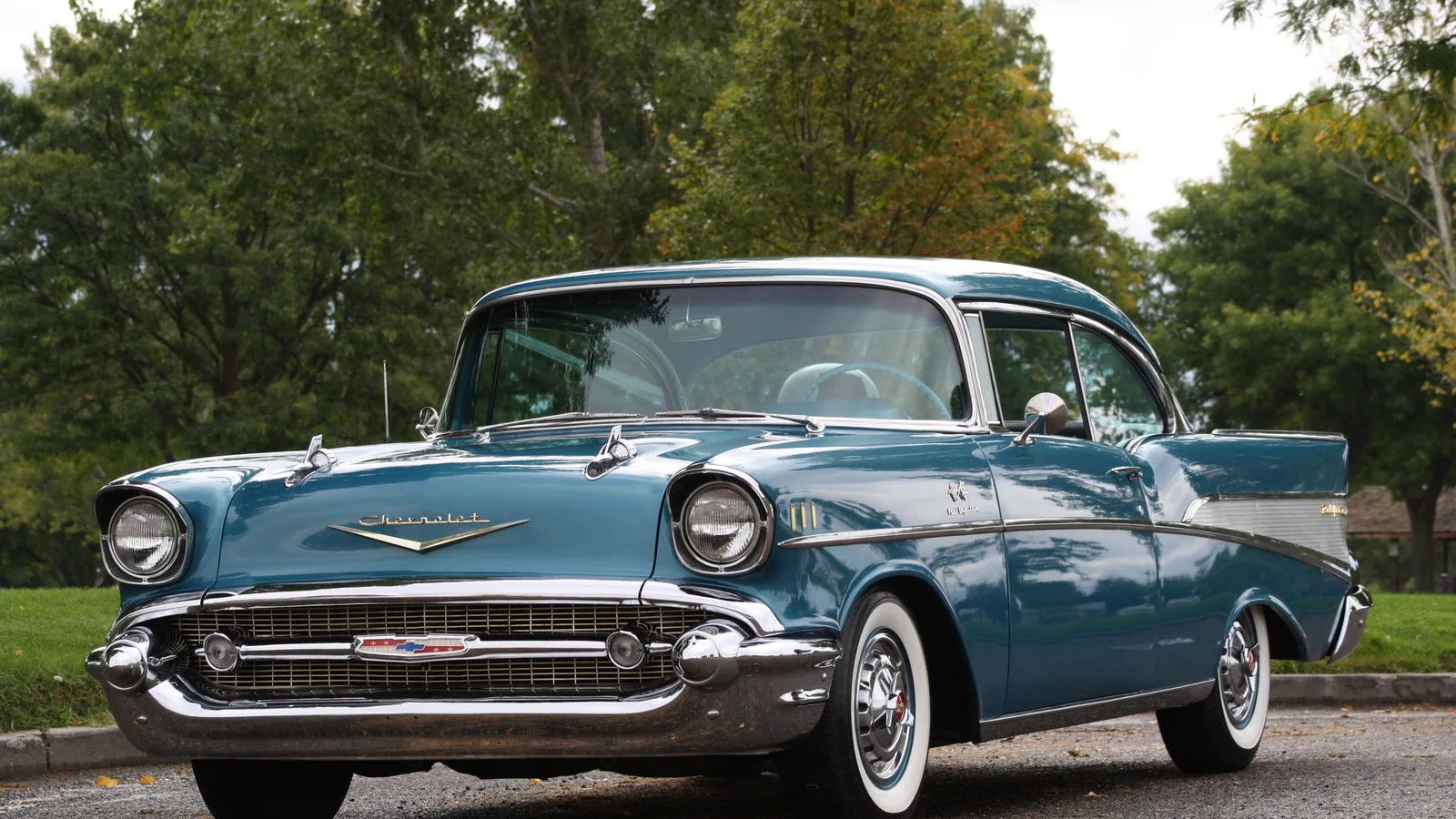
Ask someone to picture a classic American car from the 1950s and there is a good chance they will imagine something like a 1957 Chevrolet Bel Air: a broad chrome bumper, whitewall tires, two-tone paint, tailfins, a wide bench seat and a V8 under the hood.
It came from an America in which design seemed to promise that everything could be larger, faster and more modern. Yet the 1957 Chevrolet was not the unqualified winner of that year's sales race. Ford built more 1957-model cars, while calendar-year totals tell a much closer and slightly different story. Nearly seven decades later, however, the Bel Air is the car many people choose to represent the decade. How did that happen?
At first, Bel Air was not a model family
The Bel Air name first appeared in Chevrolet's 1950 range. It did not yet identify a complete series: it was used for a distinctive two-door hardtop in the Styleline DeLuxe line. The idea was to combine the airy appearance of a convertible with a fixed steel roof. With the side windows lowered, there was no conventional pillar extending to the roof between the front and rear glass, giving the car an unusually open profile.
The concept found an audience. In 1953 Chevrolet turned Bel Air into its premium regular passenger-car series, positioned above the One-Fifty and Two-Ten. It was still a mass-market Chevrolet, but extra brightwork, richer interiors and a more polished presentation gave buyers a taste of the style associated with more expensive cars.
1955: the year everything changed
The 1955 Chevrolet was such a decisive break that enthusiasts now group the 1955, 1956 and 1957 cars under one name: the Tri-Fives. The new body looked lower, wider and cleaner than its predecessor. The most consequential change, however, was under the hood.
Chevrolet introduced its new 265-cubic-inch small-block V8. The standard two-barrel version was rated at 162 horsepower, while the Power Pack version with a four-barrel carburetor and dual exhaust was rated at 180. The numbers alone tell only part of the story: the compact small-block architecture would grow into one of the most influential and long-lived American engine families.
Chevrolet Performance: the history of the small-block V81956: more chrome, more power
Annual styling changes mattered in the 1950s: buyers were expected to recognize the new model from across the street. For 1956 the Bel Air gained a revised front end, additional brightwork and altered body details. Performance moved forward too. The 205-horsepower Super Turbo-Fire V8 arrived, followed by a 225-horsepower 265 with two four-barrel carburetors. Period specifications compiled by Hagerty put a properly equipped car's 0–60 mph time at about 8.9 seconds—serious pace for a family Chevrolet of the era.
Hagerty: 1956 Chevrolet Bel Air specifications and history1957: the Chevrolet almost everyone recognizes
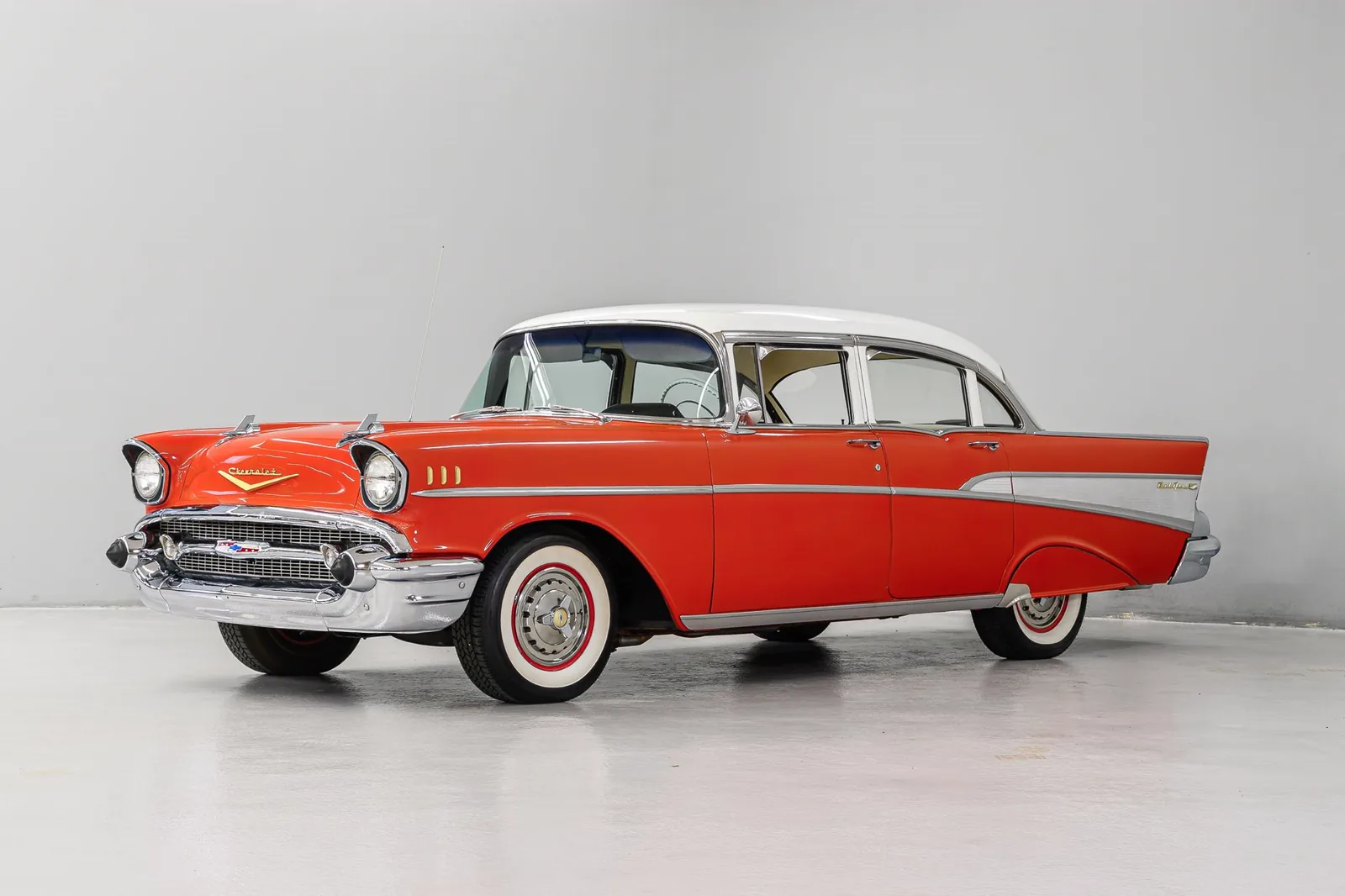
The 1957 Chevrolet was not created in isolation from the previous two years, but its details came together with unusual force: the wide chrome grille, twin hood ornaments, crisp rear fins, sweeping Bel Air side trim and contrasting paint panels produced a silhouette that is difficult to confuse with anything else. Even people who cannot name the model often recognize it as the archetypal 1950s American car.
Something special happened under the hood too
For 1957 Chevrolet enlarged the small-block to 283 cubic inches and offered it in several states of tune. Depending on carburetion and specification, advertised outputs included 185, 220, 245 and 270 horsepower. The headline version used Rochester Ramjet mechanical fuel injection and solid lifters to reach an advertised 283 horsepower: one horsepower for every cubic inch of displacement.
General Motors Heritage Archive: 1957 Chevrolet vehicle information kitFord won the model year; Chevrolet won the afterlife
The familiar claim that Ford outsold Chevrolet in 1957 needs a definition. On a model-year basis, Ford built more 1957-specification cars than Chevrolet. Calendar-year figures commonly cited by historians are virtually tied and put Chevrolet fractionally ahead. The apparent contradiction comes from counting different production and sales periods, not from one side necessarily being wrong.
| Comparison | What it shows |
|---|---|
| 1957 model year | Ford produced more 1957-specification cars than Chevrolet |
| 1957 calendar year | Commonly cited totals put Chevrolet only about a hundred cars ahead of Ford |
| Cultural legacy | The 1957 Chevrolet became one of the decade's most recognizable automotive symbols |
It did not become a legend while it was new
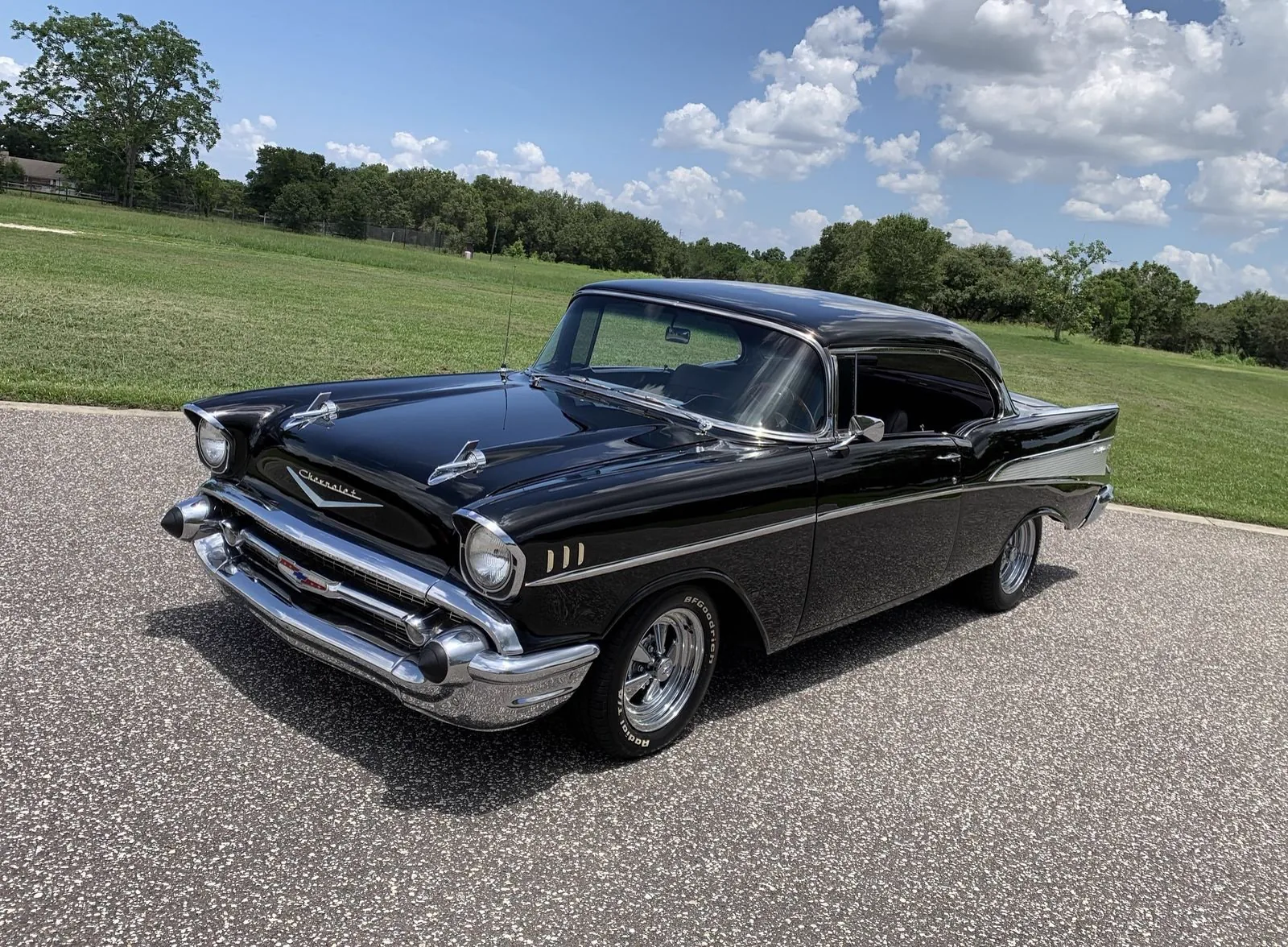
The Bel Air's reputation was built by several generations. By the 1960s and 1970s, 1955–57 Chevrolets had become affordable used cars. Their conventional rear-wheel-drive layout, widely supported small-block engines and large parts ecosystem made them natural material for hot rods, street machines and drag cars.
The first generation bought them new. The next modified and raced them. Later owners restored them, and today still others reinterpret them as restomods with modern engines, brakes, suspension and comfort equipment. The black car pictured above is a reminder of that continuing culture: the Bel Air is both preserved history and a platform people keep reinventing.
Bel Air did not mean one body style
Say “1957 Bel Air” and many people picture the two-door Sport Coupe. The series was much broader: Chevrolet offered two- and four-door sedans, pillarless two- and four-door hardtops, a convertible and station wagons. The most distinctive wagon was the two-door Nomad, which combined family-car practicality with dramatically slanted rear pillars and model-specific detailing.
An optimistic America wrapped in chrome
Postwar America was changing rapidly. Suburbs expanded, interstate highways took shape, and drive-in restaurants and cinemas became part of popular life. For a growing number of families the car was not simply transportation; it was a visible expression of mobility, prosperity and personal identity.
A Bel Air was not a Cadillac and did not pretend to be one. It offered ordinary buyers some of the spectacle associated with more expensive cars: abundant brightwork, vivid colors, available V8 power, automatic transmissions and comfort options. That balance—familiar enough to become part of family life, dramatic enough to be remembered—may be the key to its enduring appeal.
Did you know?
- The Bel Air name appeared in 1950, five years before the first Tri-Five Chevrolet.
- The highest-rated 1957 fuel-injected 283 V8 advertised one horsepower per cubic inch, but it was only one of several available engines.
- The 1957 fuel filler was concealed behind a hinged section of chrome trim above the left taillight.
- General Motors records approximately 47,000 Bel Air convertibles for the 1957 model year.
- When new, the Bel Air was everyday transportation for many families; its status as an untouchable cultural icon came later.
Why the 1957 model?
There is no single answer. It was not America's rarest or most expensive car, nor was it an exotic sports machine. Perhaps that is precisely the point. The Bel Air was attainable enough for millions of personal memories to gather around it, yet theatrical enough to stop people in their tracks decades later.
A well-kept 1957 Bel Air seems to contain an entire era in its bodywork: a time when American optimism was expressed in color, chrome and motion. That is why it became more than a classic Chevrolet. It became a memory of an America that now survives in photographs, films and carefully preserved garages.