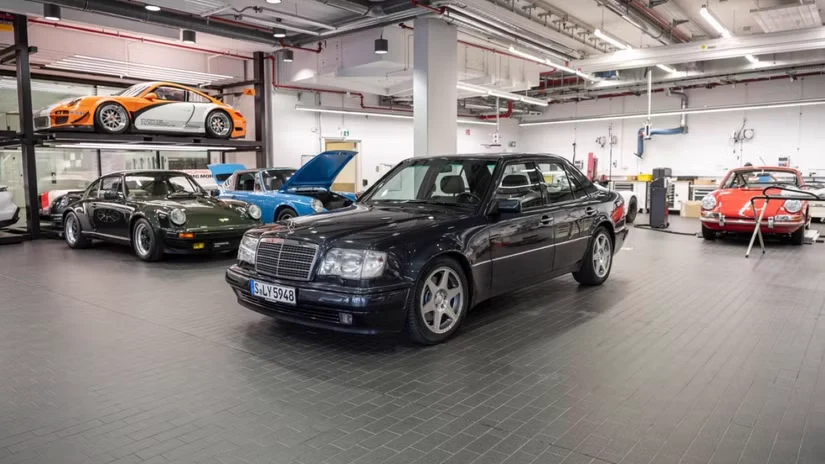
A good W124 still gets a second look in a parking lot. So do the big S-Class sedans, R129 SL roadsters, and the less common performance cars from the same period. For some European buyers, the United States is one place to look for them: a large market with its own colors, equipment, histories, and pitfalls. The most intriguing of these finds may be the Mercedes-Benz 500E, a discreet four-door sedan whose path through production ran straight through Porsche.
Its appeal is easier to understand once you look past the badge. The 500E brought a large V8 and serious high-speed ability to the familiar W124 shape, then hid much of the work beneath a carefully altered body. Mercedes-Benz supplied the idea, engine, and identity; Porsche helped turn a demanding concept into a car customers could buy.
The Mercedes that needed Porsche
The W124 had been on the road since 1984, admired for its restrained design and long-distance composure. By the late 1980s Mercedes-Benz wanted a much faster flagship for the range. The five-liter M119 V8 associated with the R129 500 SL was a compelling starting point, but fitting it into a W124 was not a matter of changing engine mounts. The front structure and cooling air path needed work; larger tires called for wider fenders, while brakes, suspension, and other components had to suit the new performance.
Mercedes-Benz turned to Porsche for development and assembly work. Porsche engineers worked on the integration of the drivetrain and body components, and the Zuffenhausen facilities had room for the specialized assembly that the wider sedan required. That is the precise answer to the familiar question “Did Porsche build the 500E?” Porsche did substantial development and assembly work, but it was a Mercedes-Benz vehicle produced through a partnership, with Mercedes-Benz providing key components and handling painting and delivery.
An unusual trip between two factories
The production route reads almost like a map of Stuttgart. Mercedes-Benz sent body parts from Sindelfingen to Porsche in Zuffenhausen. Porsche assembled the body, including its distinctive widened front fenders. The unfinished shell went back to Sindelfingen for paint. It returned to Zuffenhausen for final assembly and engine installation, and Mercedes-Benz handled delivery. Porsche says the process took about 18 days per car. This was not a standard W124 rolling uninterrupted down one assembly line.
That journey is part of the car’s charm, but it also explains its complexity. The partners needed parts in the right place at the right time and had to make a wide-bodied sedan fit into an existing model family without losing Mercedes-Benz refinement. The result was presented at the 1990 Paris Motor Show; series cars followed in 1991.
A V8 under a tailored W124 suit
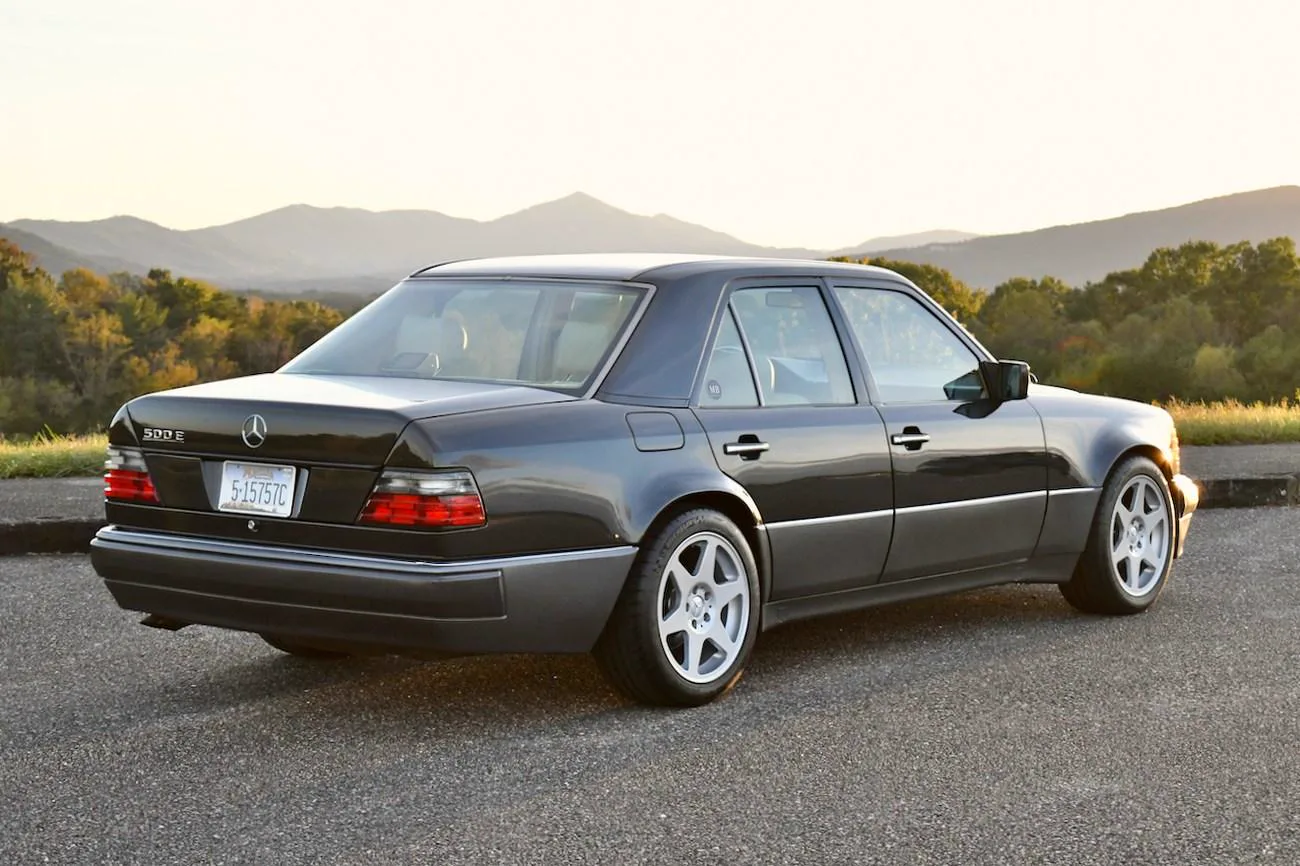
The 500E was fast without advertising the fact from a block away. Its flared fenders made space for broader tires. The body sat lower, and the front apron and fog lights differed from ordinary W124 sedans. Those changes are easy to miss in traffic. The engine is harder to overlook: a naturally aspirated, 4,973 cc M119 V8, driving the rear wheels through a four-speed automatic.
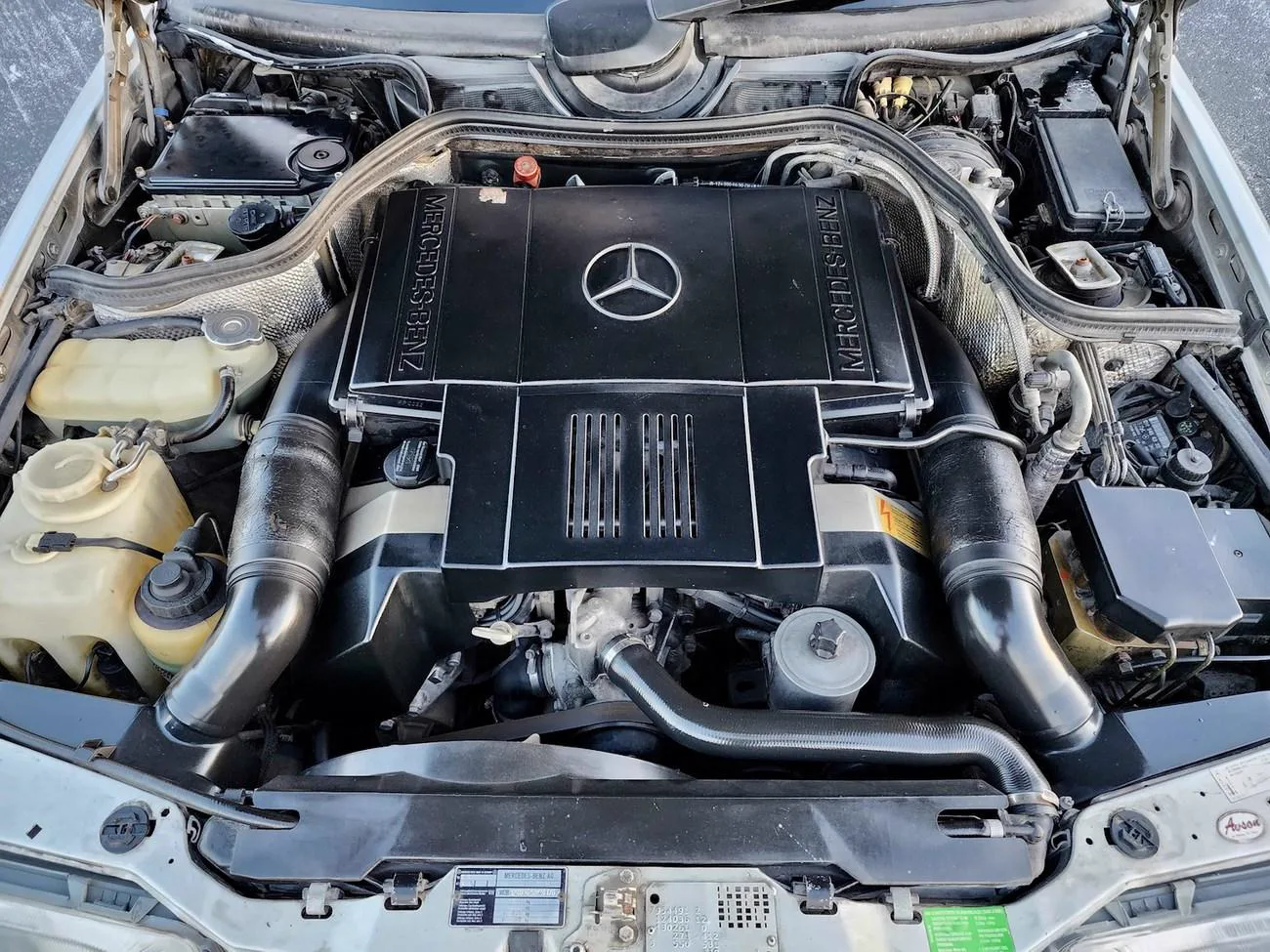
For the European launch specification, Mercedes-Benz quoted 240 kW, or 326 metric horsepower (PS). Its contemporary factory account gives approximately 5.9 seconds from 0 to 100 km/h and an electronically limited 250 km/h top speed. Porsche’s later retrospective quotes 6.1 seconds for some model years, a useful reminder that figures depend on year and specification. U.S. horsepower ratings should not be read as a direct conversion of the European PS figure.
| European launch specification | Mercedes-Benz 500E |
|---|---|
| Engine | M119 naturally aspirated V8 |
| Displacement | 4,973 cc |
| Output | 240 kW / 326 PS |
| Transmission | Four-speed automatic |
| Drive | Rear-wheel drive |
| 0–100 km/h | About 5.9 seconds |
| Top speed | 250 km/h, electronically limited |
500E or E500: what changed?
These are chapters of the same model story, not unrelated cars. With the 1993 update to the W124 range and the introduction of the E-Class naming convention, the 500E became the E500. In the United States the revised car corresponds to the 1994 model year. The facelift brought visible detail changes, so identifying a particular car means checking its year, market specification, VIN, and original equipment rather than relying on the trunk badge alone.
Mercedes-Benz records 10,479 cars across the 500E/E500 model family through April 1995, including E60 AMG variants. That number does not describe only the early cars wearing the 500E badge. The E60 AMG was a separate, more powerful derivative; an E500 Limited was also offered late in the run. Such distinctions matter whenever a seller invokes rarity.
Why collectors keep looking
The 500E has several qualities that are difficult to reproduce: a recognizably Mercedes-Benz driving character, an engineering partnership with a clear paper trail, a limited production run, and styling that rewards a closer look. It is also usable as a car rather than merely impressive as an object. Four doors and a quiet cabin sit alongside performance that felt startling in an early-1990s sedan.
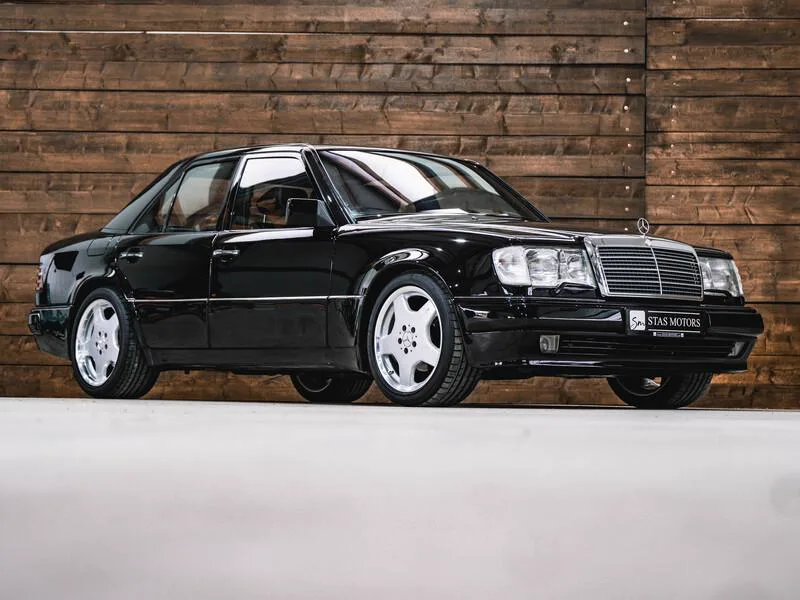
One remarkable result shows how far the top of the market can sit from an ordinary listing: a 1992 500E with about 2,000 miles sold at the March 2026 Gooding Christie’s Amelia Island auction for a reported $357,000. That was an exceptional individual car, not a typical valuation. Condition, mileage, originality, accident history, maintenance records, provenance, specification, and demand all matter. No collector car comes with guaranteed appreciation.
CLASSIC.com: 1992 500E auction result, March 2026More Mercedes classics from the period
The 500E makes more sense in the company of its contemporaries. An ordinary W124 sedan shows the foundation beneath the V8 car; the S124 wagon applies much of that generation’s thinking to a practical estate body. The W140 S-Class pursued comfort and technical ambition on a grander scale, while the R129 SL gave the M119 engine a very different setting. The W463 G-Class has its own off-road lineage and a remarkably different driving character. Each family contains many engines and conditions; the badge or body code alone does not make every example collectible.
Why look in the United States?
The American market offers scale and variety. A European enthusiast may find a color, interior, equipment combination, or documented example that is difficult to locate at home. Regional climate can influence the condition of a car, but geography is only a clue: a dry-state plate cannot rule out old repairs, water damage, corrosion, or years spent elsewhere. U.S.-market equipment and emissions details can also differ from European cars. The best reason to buy across the Atlantic is a convincing individual vehicle, not an assumption that every American example is cheaper or better.
What to check before buying
Start with the VIN and the title. Match identifiers on the car to the paperwork, check the title status and ownership chain, and obtain a vehicle-history report without treating it as a substitute for inspection. Ask for service invoices, photographs of the underside and common corrosion areas, and evidence of past body repairs. A specialist pre-purchase inspection should cover the engine, transmission, brakes, cooling system, suspension, and electrical systems. On a 500E, the engine wiring harness, fluid leaks, suspension condition, and cooling-system health deserve explicit attention.
Originality matters, but it is not a reason to ignore sound repairs. Verify that claimed special equipment or a rare variant is supported by records. Before paying, confirm that the title and vehicle status allow export, and research the destination country’s customs, registration, and technical requirements with the relevant specialists. These rules vary by country and by vehicle; a vintage badge does not automatically secure favorable treatment.
For the purchase stage, see our U.S. vehicle purchase assistance guide.
Planning the ocean journey
A classic Mercedes can be shipped from the United States to Europe when its documentation, condition, and proposed transport arrangement meet the applicable requirements. Containerized transportation is one option for an eligible car. Collection from the seller, condition records, careful loading and securing, route selection, and export paperwork all need to be planned before the ocean leg. The right arrangement depends on the car and the destination, so shipping is best considered before a purchase is final.
Our vehicle shipping page explains the available planning steps.
For a closer look at the route to Hungary, read our USA-to-Hungary vehicle shipping guide.
The 500E remains appealing because it feels coherent. The V8, the subtly altered W124 body, and the improbable back-and-forth between Mercedes-Benz and Porsche all serve the same idea: a sedan that could cover ground quickly without giving up its composure. Finding the right example takes more patience than admiring one in a photograph. That is part of the pleasure of the search.
East Coast Freight Logistics is an FMC Licensed Ocean Freight Forwarder (FMC License No. 035782). For an eligible classic or modern vehicle bought in the United States, including purchases in Florida, we can help coordinate the ocean transportation to Europe with the appropriate partners. Share the listing and destination when you request a quote so the route, handling, and documentation can be reviewed for that specific car.